

Blogs, Insights

Google blocked or removed more than 292 million policy-violating reviews in 2025, according to its own Google Maps report. If your venues rely on Google ratings for visibility and footfall, the ground has shifted.
For multi-site hospitality operators, Google review removal is no longer a background issue. Venue reviews are disappearing because enforcement is now proactive and retroactive, and the 2026 policy update targets practices that many hospitality groups treat as routine. A 4.6 rating built over three years can fall overnight, and the cause is rarely obvious.
HGEM manages reviews for multi-site operators. This article sets out what Google's AI is looking for, which review practices to change and how to build a rating that lasts.
Google's AI scans for patterns and removes reviews retroactively.
A consistent review programme across many venues can look like coordination to Google's AI.
Steady volume, open prompts and post-visit asks protect a rating. Campaigns and scripts put it at risk.
Staff review quotas, asking guests to name team members, guided scripts and on-site review prompts all breach Google's rules.
For years, Google's approach to fake or manipulated reviews was largely reactive. A review was flagged, a complaint was raised and the content came down afterwards. That has changed.
Google's AI now scans for patterns and anomalies and removes content retroactively. Operators often find out only when a rating drops. Google has started sending alerts in some cases, such as when it removes suspicious five-star reviews, but the explanation is rarely detailed. A formal appeals process exists, though operators should not rely on it to restore lost reviews.
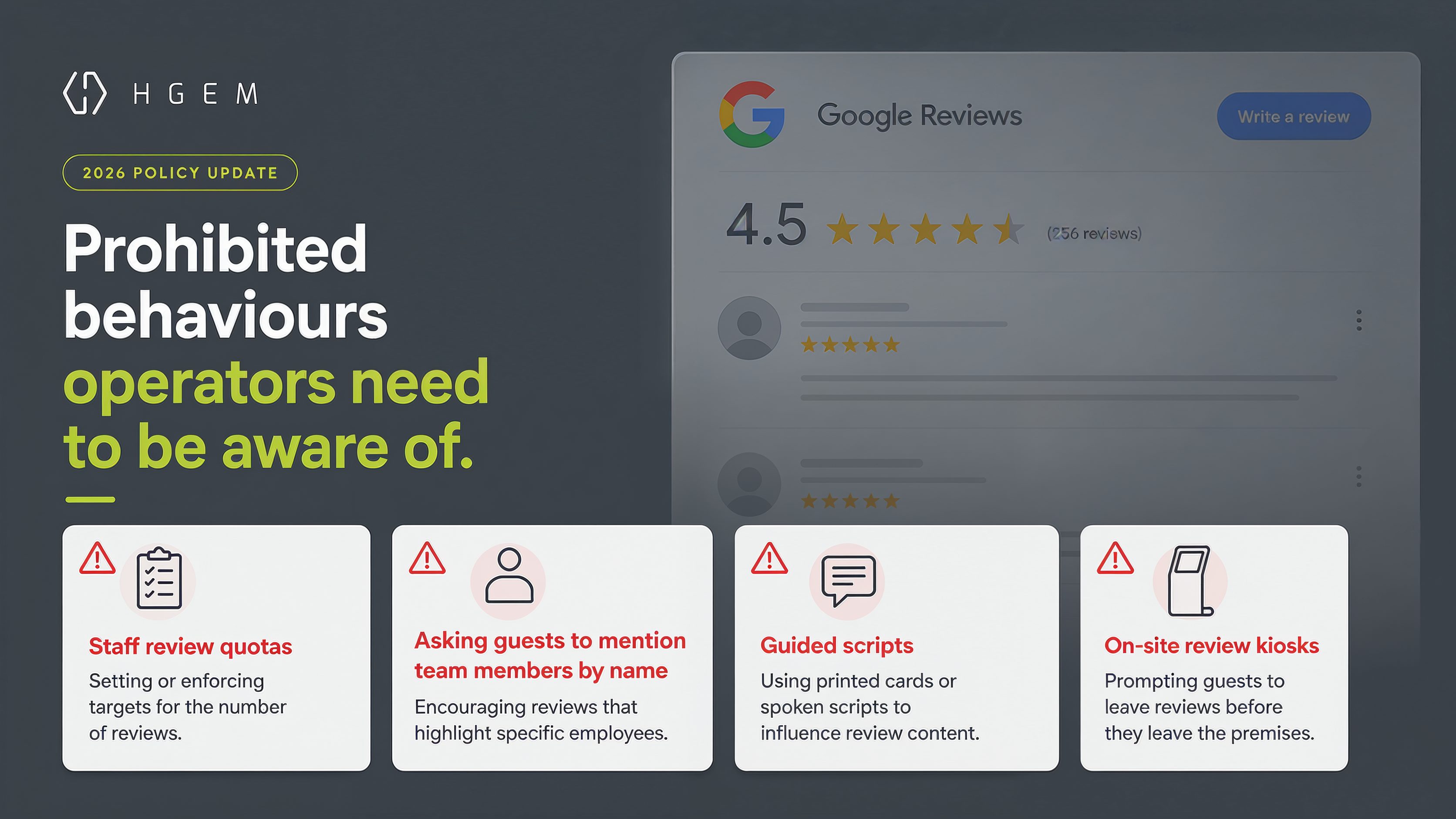
Google's reviews policy now rules out four practices that many hospitality groups treat as routine:
Staff review quotas. Setting or enforcing targets for the number of reviews.
Asking guests to mention team members by name. Encouraging reviews that highlight specific employees.
Guided scripts. Using printed cards or spoken scripts to influence review content.
On-site review prompts. Kiosks or requests that pressure guests to review before they leave the premises.
Plenty of hospitality review programmes tick at least one of these boxes, often without anyone realising.
High-volume review categories tend to see the most deletions, and hospitality sits squarely in that group.
The problem for multi-site operators is pattern recognition. A group running the same review programme across 20, 50 or 100 venues, with the same timing, the same script and the same phrasing in the ask, looks very like the coordinated behaviour Google's AI is trained to detect.
"Review of the month" competitions, staff KPIs tied to review counts and incentivised review drives are now counterproductive. They are likely to trigger deletion at scale.
The harder lesson is that reviews are no longer durable assets. Longevity does not protect a rating. Only the integrity of how the reviews were gathered does.
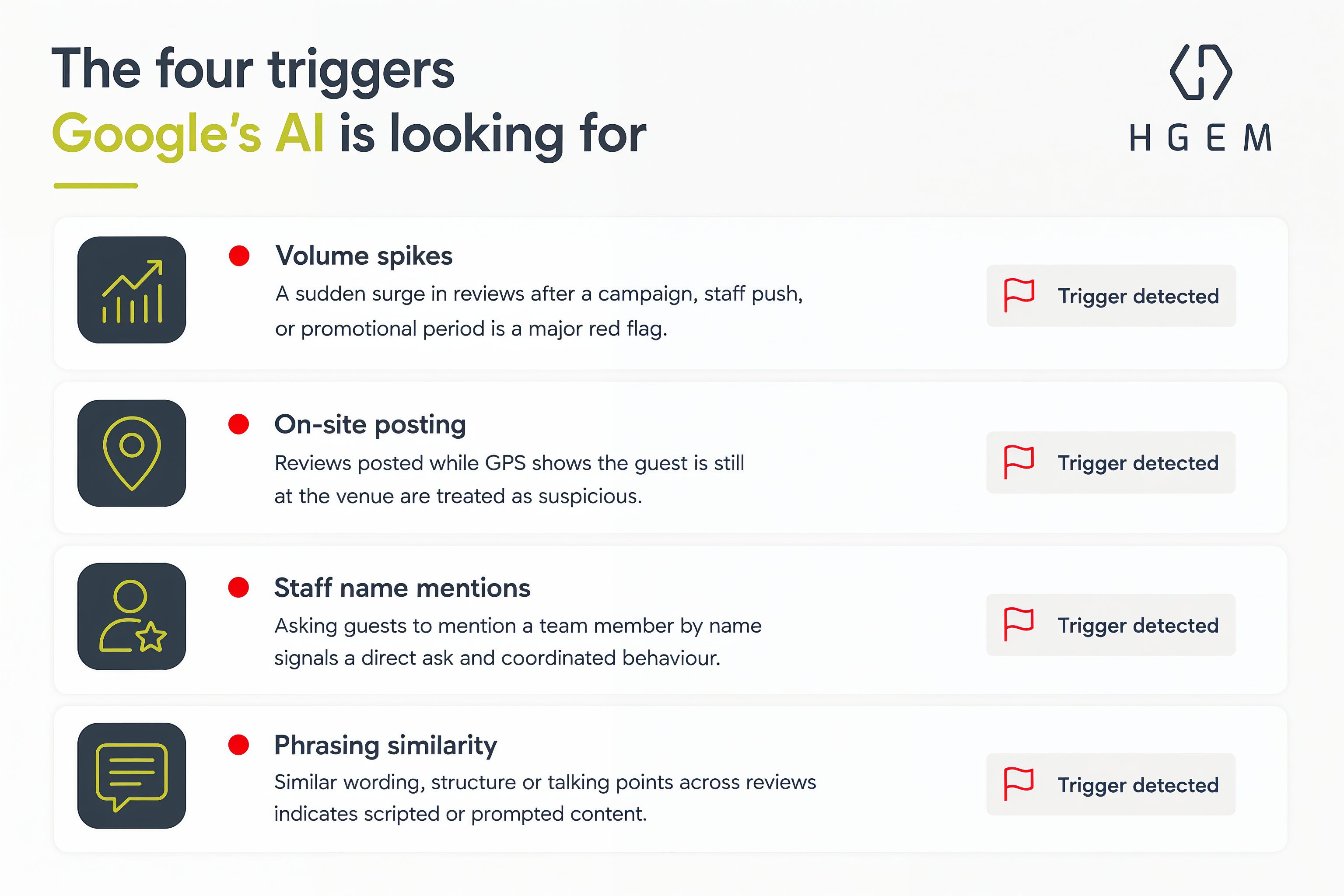
The banned practices above are the rules. Google's AI enforces them by spotting the patterns they leave behind. According to review specialists ReviewTrackers, four patterns are most likely to get hospitality reviews flagged. Quotas and review pushes show up as volume spikes, kiosks as on-site posting, name requests as staff name mentions and scripts as similar phrasing.
Volume spikes. A surge in reviews after a campaign, a staff push or a promotion is one of the clearest signals Google's AI catches. A venue that normally receives three to five reviews a week does not attract 40 in a weekend without something coordinated happening. The spike is the flag, even when every review is real. Natural review behaviour is steady. Campaign-driven intensity is not.
On-site posting. A review posted while GPS data places the guest at the venue can look suspicious. Reviews are designed for reflection after the experience, not for a kiosk at the table. Any system that asks guests to review before they leave is a liability.
Staff name mentions. This one surprises operators most. Asking a guest to "mention Sophie by name" feels personal and authentic. From Google's perspective, it signals a direct ask, and a coordinated one. When several venues produce reviews that name staff in the same structure, the pattern reads as scripted. The intent was genuine, but the output tells Google's AI a different story.
Phrasing similarity. When reviews across a venue or group share sentence structures, phrases or the same order of talking points, they look script-derived. Printing suggested wording on feedback cards, or training staff to tell guests what to say, produces reviews that are vulnerable to bulk deletion. Authentic reviews vary naturally. Consistent language is a red flag.
The answer is not to stop encouraging reviews. Volume and recency are still important. What needs to change is how the ask is framed and how the programme is paced.
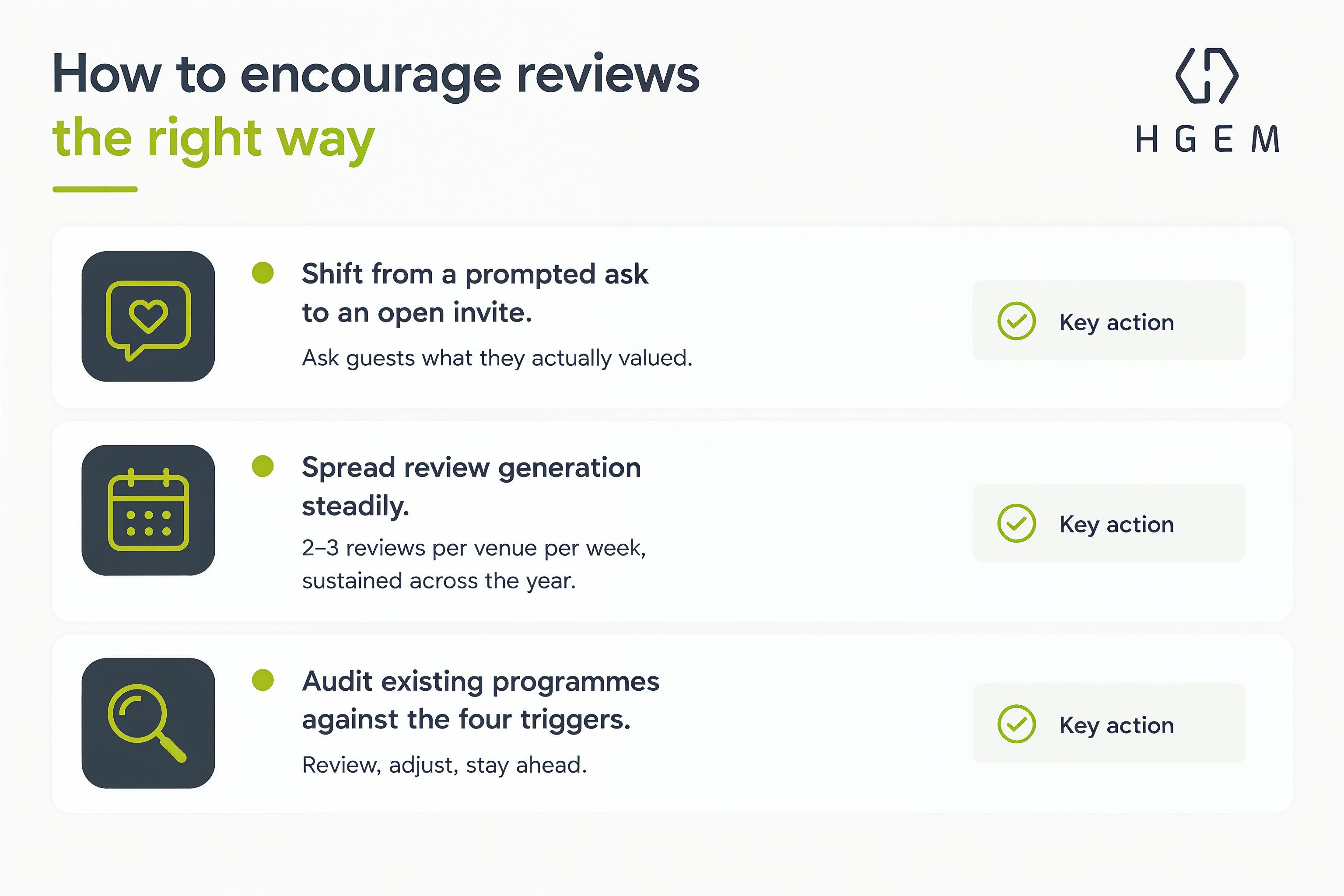
Shift from a prompted ask to an open invite. Ask guests what they actually valued, rather than telling them to mention a team member. "Did the vegan menu work for you? Tell us about it. Brought the family? Let others know what it was like. Celebrating something? Share what made it special." Prompts like these produce specific, varied language because the experiences behind them are real. Send the request once the guest has left, by receipt, email or SMS, rather than at the table.
Spread review generation steadily. Aim for two to three reviews per venue per week, sustained across the year. That is worth far more than 20 in a single weekend. Consistency signals credibility. Intensity raises flags.
Audit existing programmes against the four triggers. If any element of the current approach matches a pattern Google scans for, change it now. Waiting until reviews disappear is too late. The five highest-risk questions are whether you have staff review targets, name requests, scripts, on-site prompts or review campaigns. Review, adjust, stay ahead.
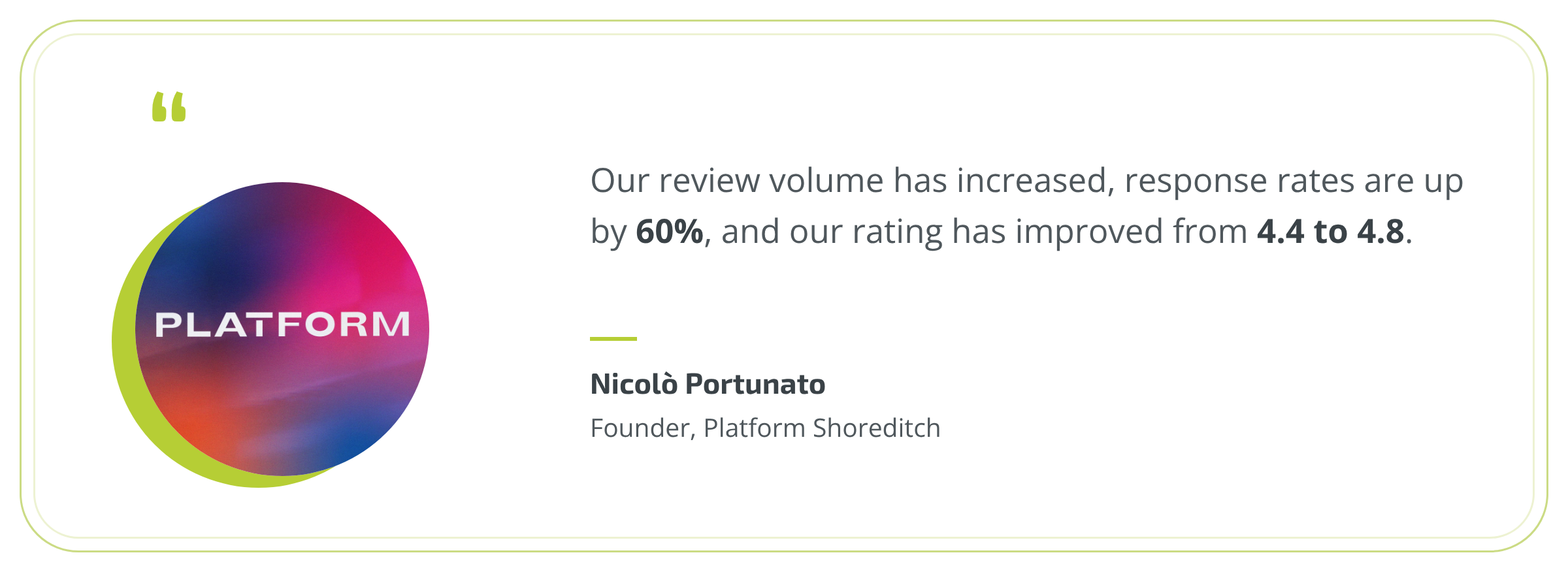
The operators making this work treat review management as an ongoing discipline, not a campaign. Platform Shoreditch is one example.
There is a second reason to change how the ask is framed. Google Gemini now generates venue descriptions in AI-powered local search results, pulling specific phrases from reviews. When someone searches for a family-friendly restaurant, an accessible bar or a venue with a rooftop terrace, the description is built from what guests have written.
Reviews that say "great service" give that system little to work with. Reviews that describe the vegan menu, the accessibility or the atmosphere on a Saturday afternoon give it real copy. A guest who describes their experience in their own words does more than add to a star rating. They write the description Google shows when it recommends your venue.
Your Google Business Profile supports the same goal. Keep the description specific, upload photos at least monthly, keep opening hours accurate (including seasonal and holiday changes), post at least fortnightly and reply to every review.
To review-proof your venues, download our guide, which includes a 10-point audit checklist and before-and-after solicitation scripts. To see how review management works in practice, including volume monitoring that flags unusual patterns, read about HGEM's review management.


